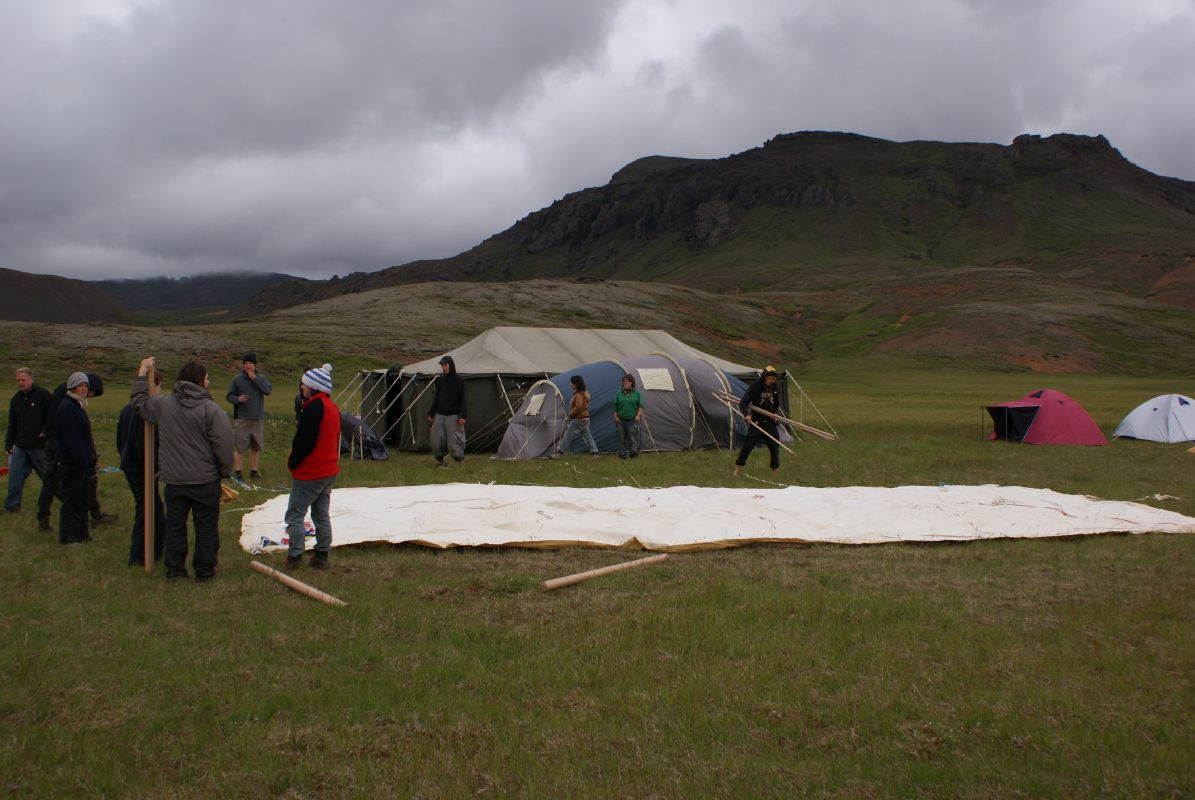
A summer of International dissent and action against Heavy Industry – swarming around Iceland from the 12th of July 2008!
The camp this year will commence in the Hengill geothermal area, about one mile from the Hellisheidi power plant that is currently being expanded to power Rio Tinto – Alcan and Century smelters.
Location:
Hellisheidi, Hengill. Click here for directions.
Date:
The camp program starts July 12th with a program of skill and information sharing workshops, so be there by Friday the 11th, from which date camping and food will be available.
If you are a foreigner and planning to come to Iceland, we suggest you arrive on the Smyril Line ferry on the 3rd or 10th of July. If you need accomation before the 10th, this will be arranged – please get in touch.
Practicalities
- Food:
Vegan meals will be provided throughout the camp by the new Icelandic mobile field kitchen that was setup last year. Food will be free/donation for those coming from other countries and served on a donation basis to others.
If you are an Icelander, we very much welcome food donations, preferably rice, pasta, potatoes, vegetables, fruit and bread.
If you are interested in joining the cooking crew and becoming a fully trained to cook for large groups of people, please email us: resources [at] savingiceland.org or knock on the kitchen tent’s door.
- Money:
Iceland is a famously expensive place to visit but at the camp you will not need to spend any money. Also, if you hitch-hike, use a tent and shop well at stores like Bónus you can live cheaply. When entering Iceland you legally must be able to prove that you have enough money to fund your stay, otherwise the border cops might not let you enter the country. For this you can either point to some cash on you or just show a credit/debit card. This shouldn’t be a problem, dont worry.
Travelling to Iceland:
- Boat:
Smyril Line sails from Denmark (Hanstholm), Norway (Bergen) and Scotland (Scrabster) to Iceland (Seyðisfjörður, in the East of Iceland). Prices tend to be cheapest if you book with their Danish office (they speak English). Paying in Danish Krona is supposedly cheapest.
If you remind Smyril Line that you are a “student” then you will get a good discount. You can usually easily change your ticket without any extra cost.
If you are able to bring a car, this is well worth it and does not usually cost much more then four foot passenger returns).
You are encouraged to arrive the 3rd or the 10th of July.
Whilst sailing look out for whales and dolphins…
Smyril-line – Ferry from Scotland, Denmark and Norway to Seydisfjordur.
- Plane:
International flights usually land in Iceland’s main airport, Keflavik. An airport transfer bus service (called the FlyBus) runs between the airport and Reykjavik bus terminal via various hotels (1100 Kr [1200Kr from 01 Jan 07], 45 minutes). A return is 300 Kr cheaper than 2 singles.
Iceland Express – Flights from Denmark, Sweden, Norway, France, Spain, Netherlands, Germany and UK – This is usually the cheapest airline to Iceland.
British Airways – Flights from the UK – even cheaper than Iceland Express currently
SAS Scandinavian Airlines – Flights from Oslo
Travelling inside Iceland:
We will of course aim to coordinate any necessary camp related transport but there may be times when this is logistically impossible. Also, you may want to travel apart from the camp within Iceland. Like other Nordic countries you can legally pitch your tent on any patch of land that is not fenced off and is not in sight of someones house, for one night, apart from around Myvatn. Many villages have campsites you can pay to pitch at, and you can also stay at mountain huts and emergency shelters which are spread across the country (for info on these check a map). Check the weather report here or in the tourist information centre before you leave on a big journey
- Commercial Transport:
Iceland’s long distance bus system is slow and extremely expensive, so you might want to consider other means of travelling.
Bus Seydisfjordur – Egilsstadir: http://www.nat.is/travelguideeng/bus_stop_seydisfiord_egilsstadir.htm
More busroutes and other practical info:
http://www.nat.is/travelguideeng/transportation1.htm
Internal flights are cheaper than buses but they obviously produce huge amounts of planet killing fumes [Air Iceland – Internal flights]
Renting a car is also very expensive for extended periods of time.
- Hitch-hiking:
It is generally safe to hitch-hike and this kind of travel has lead to lots of exciting road-trips. Iceland has only one highway, Route 1, and it circles the island. Whether you should head along the North or South Route 1 is a matter of raging opinion which will never be settled. Hitching from Egilstadir to Reykjavik will usually take anything between one and four days. Make sure you stock up on supplies before you set off on a long journey, as you will not pass many shops. Try to travel in pairs if possible and be prepared to be unlucky and not get a ride for possibly a day or two. Make sure you have a tent if you hitch-hike.
- By Bike:
Many people cycle around Iceland. It is 800km from Seydisfjordur to Reykjavik along the south route of Route 1, and it is mostly flat with a few insane hills. You should judge for yourself how long this will take you but we estimate that it will take you about 10 days to cross the country. The north Route of Route 1 is longer and crosses through the mountaneous interior highlands of Iceland. There are not many opportunities to buy food along the way so make sure you are well stocked and equiped.
Icebike.net – Very Useful general information of cycling in Iceland
- By Car:
Cars of all kinds are extreemly useful: 4x4s, mini buses and vans especially, though small cars that don’t use much fuel are too. The cheapest way to travel on the Smyril-Line Norona ship is to fill your car up with people. If you email us in advance, we may be able to organise people to share your seats and cost.
You can circle the country in the summer in a usual road car without a problem. But, entering the central-highlands in something other than a 4×4 can be highly problematic. Most of the Central-Highlands roads are just mud tracks, meaning that they are extremely potholed and can have rivers running through them. We say this as a caution, but many people do take these sorts of vehicles through 4×4 tracks… The higher your vehicle is off the ground the better. Most mountain roads and roads in the interior of Iceland have a surface of loose gravel. The same applies to large sections of the national highway, but which also has long stretches of asphalt. The surface on the gravel roads is often loose, especially along the sides of the roads, so one should drive carefully and slow down whenever approaching an oncoming car. Always observe speed limits, they are there for very valid reasons. The mountain roads are also often very narrow, and are not made for speeding. The same goes for bridges, most are only wide enough for one car at a time. In addition to not having an asphalt surface, the mountain roads are often very windy. Journeys therefore often take longer than might be expected.
For information on road conditions, Tel.: +354-1777, daily 8:00-16:00. or click here
According to the law everyone must drive with their headlights on, even in daytime. The general speed limit is 50 km/h in urban areas, 80 km/h on gravel roads in rural areas, and 90 km/h on asphalt roads. Always slow greatly down before approaching a bridge. Even relatively smooth roads have nasty potholes on either side of bridges. Asphalt roads tend to change suddenly and even without warning into gravel roads. That can be very dangerous if you are not driving at a sensible speed and has often caused terrible accidents. Traffic sign posting in Iceland is to put it mildly, sloppy. Don’t trust maps just because they show drivable tracks. Mountain tracks can suddenly vanish or become unusable. Be extreemly cautious when crossing rivers. Small streams tend to swell into forcefull rivers in the afternoons, so are best crossed early in the morning. Always make sure another vehicle is present when crossing a river. Expect roaming herds of sheep and cows on roads when driving anywhere in the countryside, and if you knock a sheep over then you legally have to contact the relevant farmer immediately. Petrol stations are few and far between around Iceland and are non-existent in the highlands, so make sure you always fill up when possible,and have spare cans. STICK ONLY TO THE ROADS AS OFF-ROAD DRIVING in the summer IS VERY DESTRUCTIVE TO THE FRAGILE SUB-ARCTIC ICELANDIC VEGETATION, and is also illegal.
What to Bring:
- Absolute essentials:
* Waterproof clothing (Coat and trousers), it can rain horrendously.
* Good hiking shoes (trainers can be very dangerous in the highlands.)
* Thermal underwear (it can get very cold!)
* Other warm clothing (eg wool jumpers, gloves, etc.)
* Summertime clothing – it’s not always cold!
* Double skinned tent (or find someone to share with.)
* At least a two season sleeping bag, three season highly recommended but not essential.
- Highly recommended:
* Camera / video-camera. Especially digital equipment (these are invaluable at the camp). Lots of DV tapes are also very useful.
* Your own cutlery (knife/fork/spoon),
* Plate or bowl and a cup
* Camping cooking equipment (especially if you go travelling on your own)
* Torch
* Maps
* Compass
* GPS
* Medical equipment
* If you are sensitive to light when trying to sleep then you should bring an eye mask because the sun will be in the sky all night.
* Cars of all kinds, 4x4s, mini buses and vans especially, though small cars that don’t use much fuel are also useful. These are incredibly useful for the camp functioning.
* Mobile phones, especially NMT phones that are more useful the highlands.
* An Icelandic sim card. These are free with Siminn if you buy credit. A good place to get them is the Siminn shop in Egilsstadir near the Bonus or in Keflavik airport. Highly recommended.
* Suncream.
- For actions:
(The police might try to confiscate these when you enter, think of a reason why you might need them that’s not connected to the camp)
* Climbing harness
* Climbing clips
* Bicycle locks
* Paints and brushes.
* Banners
- For the camp:
* Your driving licence, so you can drive a camp car.
* Food for the camp kitchen. In particular please bring special vegan products. This is a country whose biggest supermarket puts milk into its humus!! You can bring in 3kg of food per person. Half/whole Kilo bags of spices (turmeric, pepper, curry etc) are useful.
* Is there an environmental/social struggle in your area? Why not bring some fliers or a film?
* Do not bring ANY drugs to the camp!
- Other
* Iceland’s growing grassroots radical library, Andspyrna, would highly appreciate donations of books, films, posters and information about social/ecological change movements from your local area. If you have anything that might be of interest then bring it along or contact them in advance if you are unsure: punknursester[at]gmail.com. The radical library is held at Kaffí Hljómalind, 23 Laugavegur, Reykjavik 101 and shall have a selection of books at this years Saving Iceland camp.
* You can legally bring in 2 liters of alcohol. Alcohol is very expensive in Iceland.
Other links
Icelandic Directorate of Immigration – VISAS etc.
LonelyPlanet
The National Land Survey of Iceland
The Icelandic Meteorological office
Hello Island,
I am Mattis from Hamburg in Germany.
I will came to the camp. I came with the plane on Wed. 16 July 08 at 22:40 h from Copenhagen to Reykjavik KEF. Then I try to came with the Bus to Laugevegur, Hljumalind.
I hope that than her is somwone to give me informations how I get to the camp.
My flight back is on the 4. august and I hope that we can do in thith time alot together against the hevy industry.
best greetings from Mattis
Mattis, surely you have something better to do than waste your time on these hippies.. why dont you just get a good job, go to school, or even just do something with your life..
Dont let these hippies get to you
Greetings Jón Brúnsteð Jóhannesson
Mattis, i will tell you where to go. !!
Take the next bus.
Or get in the next taxi.
Go to Keflavik, take the next plane to Germany.
Go to your house, take your tent.
Tent in your garden and there you have a good camping site both for you and your family.
(If you are lucky enough to have a family.)
Use the time you got to stay with your family man. !!
Don’t waist your time on those hippies man.
We here on Iceland can take care of our own business, we don’t need individuals all over the fu*****g world to “TRY” to save us.
We are in a good condition.
Greetings from East coast of Iceland
Sigurjón Kr. Björgvinsson (working in Alcoa Fjardaal)
Guys, have you got nothing better to do than hang out on a website you obviously have no interest in – if you are here, maybe you should actuallly read some of the content than spout out oh so original insults to people who actually care about something.
If people from Saving Iceland were indeed a bunch of jobless idiots singularly interested in getting stoned, do you really think that they would come to the Iceland and camp in a wet bog?
By the way, that Icelanders can take care of our own business is exactly what we are saying – why get these American plundering corporate maniacs to your communities?
Do you think these smelters are actually sustainable solutions?
What will happen in 40 or 50 years, when the dams silt up and geothermal boreholes are exhausted and the outdated smelter closes. Do you really think your children will be happy with the choices you are making now?
We needed jobs , we got jobs, we needed money , we got money, we have what we need now, thanks to the “American plundering corporate maniacs”
I would trust Alcoa with my soul. And we icelanders are taking car of our own buisness
by getting assistance from the “American plundering corporate maniacs” and what do you really think is going to happen in 40 or 50 years,, the thecnology is going to get better, and there by we are going to find new way to take care of iceland, but in the mean time , this is all we have,
and like i said, my town in east iceland http://www.east.is / http://www.fjardabyggd.is went from 600-700 people to ca. 1700 when the smelter came, otherwise my community would be dead..
So as i said, I would trust Alcoa with my soul.
Jón B Jóhannesson
“So as i said, I would trust Alcoa with my soul.”
Do you know what kind of products they produce with their aluminium and what they are used for?
Missiles, fighter jets, explosives… all used in Iraq and everywhere there is a major war. Take care who you entrust your soul to!
Goethe wrote a novel classic called Faust. I really suggest you look at it.
Thanks for commenting without abuse.
In addition to producing seriously destructive munitions Alcoa’s aluminum smelters release 6.1 million pounds of air pollution annually. They have revenue of over 30 billion dollars and yet they are consistently taken threatened with labor violations. In 2006 they had over 200 clean air violations at a single plant in The United States and even after a 9.2 million dollar fine they refused to clean up their act. Furthermore they are famous for pulling up stakes on a whim, leaving disasters behind. Please don’t bet your future on them Mr. Johannsen, they do not offer you security nor loyalty and they truly believe they are above the law.
OK- now the weather is getting better, will we see some action? arrrrrrrr
I dont care if Alcoa produce things that are used by the US government. That just brings more jobs and more money to my community, And when it comes to pollution the smelter in my town is the most evolved of smelters, the pollution here is nothing to be complaining about. What happened in the States is none of my concern.
Jón B Jóhannesson
Regarding your comments on pollution, thats what many people have thought. Have a look at this story about health & pollution at an ALCOA plant in Australia.
https://www.savingiceland.org/?p=928&language=en
Hope thats not going to be the future for fjardaal….
I think protesting is very importand but why spending time protesting for something that will only fall on death ears… both the people and the goverment… come help us protest the fuel prices or something rather then this… atleast then you will have the public on your side.
Gunnar, how can you be so false!?
In a recent poll half the Icelandic nation was against any more heavy industry!
During the building of the dams at Kárahnjúkar half the people was also roughly the percentage of those who were against the Kárahnjúkar dams. And now, today, a Gallup poll is published showing that 42% of the nation are against Century building another smelter in Helguvík. http://visir.is/article/20080717/FRETTIR01/150651612
Get you facts right Gunnar, before you send condescending messages to just about the only upright protesters in this country.
And by the way, stuff your fuel prices!
how can you ,Jón, say you will trust with your soul a big company like alcoa or any of them ,which at the end only care about money? do u really think that if something happen to any of the workers, they will really take care about u? u want an exampe of what happen with these companies?
in 1998 in Spain, Boliden the swedish company of mining and smelting of zinc,silver coal and aluminum and some other heavy metals,produced one of the major ecological disasters in Spain,u maybe had heard about,but the tailing dam was broken down and it released 4-5 million cubic meters of toxic tailings slurries and liquid into nearby Río Guadiamar. The slurry wave covered several thousand hectares of farmland, and it threatens the Doñana National Park, a UN World Heritage Area,killing lot of wildlife and of course afecting also to the potable wate in the area.
As of April 2008 (10 years after the disaster), Boliden has not paid any fine or compensation yet, despite a 2004 sentence by the Spanish Supreme Court which condemned Boliden-Apirsa to pay 45 millions euros .
i know ia not teh same company,but just to tell you in which kind of people you trust and how trustable they are.
Lets then take a look at just one of many examples of how well ALCOA take care of “their” souls:
http://www.nlcnet.org/article.php?id=237
Why is it that foreigners are intrested in saving Iceland, the most democratic and free country in the world. We had the first female elceted president in the world.
What do you have against big companies coming into our country and giving the locals a job and paying them well.
For your information when you talk about pollution from the aluminium smelting factories, each country in the world has a quota and until we reach that mark, you guys really have nothing to complain about.
Further more, I wittnesed one of your protest on Hellisheiði, and you guys where walking around with cameras, mobilephones and walkie talkies. All of those items use lithium batteries which is nonbiodegradable substance that pollutes more than a 3 tonn diesel truck in one year.
When I came up to the entrance of the place, I was told that you had closed down the working site until the media got there. And you locked yourself to the machinery and forklifts and what not. That is not a peacefull protest in my eyes, instead you seem like mediawhores, that only care about getting noticed, and not achiving anything with the protest.
Let us have our jobs and our money and get one yourself. We are a free country with freedom of speach. To stay free, we need our jobs and our paychecks.
lets not kid ourselves. first of all ” Savitri d” you seem as dumb as they come. you say that the multimillion dollar companys like alcoa aren´t loyal and they think they are above the law.
Then how come they are not arrested when they start construction?
You the protesters are the ones dragged away in handcuffs and coming into job sites without helmets and uninvited which is a misdemenor felony in Iceland. You jepordise the lives of workers by hanging in their machines and their vehicles.
Protester are the ones taking away the workers right to carry out their job. You take away our fundamental right to have a living and beeing free humans under the protection of the law.
which is more criminal?
Taking away a woman or mans future paychecks and there oppertunity to live.
Or the companys providing a small country with endless opportunitys to make a living.
Do you really think that when a smelter comes to a small 2500 people comunity, that the jobs on the smelter are the only ones. Let me tell you, NO. it brings flourishing jobs in all aspects of life. but i guess you do not have a mans best intress in mind.
Have anyone of you ever had a bluecollar job, where you can come home with a chek and be proud to have served community and your family?
Tell us what you are achiving?
Poverty vs a slightly cleaner air.
please let me see some answers from someone who is protesting.
Dear Icelandic boy,
Your comments on Iceland –
Just because Condoleezza Rice is the first female US secretary of state, it doesnt mean George Bush is the most democratic and free government the US has had.
And how democratic is it that the social democratic alliance are pushing one after the other heavy industry project forward, even though they promised a moratorium in their manifesto?
Pollution –
You are not talking about pollution, but about greenhouse gas emissions quota, which every western country has under the Kyoto protocol.
Well, let me tell you that Century-Nordural’s Helguvik smelter under construction, does not even have an emissions permit (to claim part of Iceland’s quotum). It is being built however, already 150 million $ dollars have been spent by Century on the project (figure is from their 2nd quarter 08 results). If both Helguvik and Bakki are pushed through Iceland will exceed what is is allowed to do under Kyoto.
So this is about greehouse gases.
Pollution from the smelters are another matter. Recently there was a report that sheep in the vicinity of the Century smelter in Grundartangi (which is partially powered by Hellisheidi) were suffering health/teeth problems from the smelter’s fluoride pollution.
Workers in smelters suffer more diseases, e.g. pancreatic cancer, than other workers due to exposion to the pollution.
Do you know that the Alcan smelter just dumps it’s waste including spent potlining (which is a major health hazard) into the sea? It even admits to this on it’s own website!
I dont think you can compare that with a couple of lithium batteries. It is a bit of a rediculous argument, in the line of: everyone who wants to do something against climate change should just stop breathing now…
And what is strange about foreigners protesting? Dont foreigners protest against destruction of the Amazon rainforest? Is it strange to protest against the war in Iraq?
Alcoa is an American company, Rio Tinto is registered in London. Is it strange for Americans and English people to be opposed to the operations of ‘their’ companies?
Of course you need a job and a paycheck but aluminium is an outdated, destructive way of doing it. The loggers in the Amazon also say they need their jobs and paychecks.
Any self respecting country should find sustainable ways to create jobs instead of destructive ways. I’m not telling you how to live your life, you figure it out. But I do know that the aluminium industry is making a mess around the world and is making a mess out of some of the most beautiful areas in Europe which happen to be in Iceland.
If you want to know why we were at Hellisheidi, maybe you should properly read the press release which explains why.
https://www.savingiceland.org/?p=2425&language=en
Icelandic boy said:
That is the problem with corporations. If I commit a crime, I can get prosecuted very easily. Protestors go on an action knowing they might get arrested and maybe convicted for something they believe in.
It is on the other hand very difficult to convict directors of corporations for what they have done in that function. It’s what the Ltd. stands for that you find in the names of many corporations: ‘limited’ as in ‘limited liability’. Investors and shareholders only have a limited responsibility for the actions of their companies. So nobody for example got convicted for Rio Tinto’s sandline scandal in the pacific (do a websearch) even though many people died from it.
However, companies can get sued:
Former workers sue Alcoa
http://www.jamaicaobserver.com/news/html/20080214T200000-0500_132536_OBS_FORMER_WORKERS_SUE_ALCOA_.asp
Texas groups sue Alcoa for alleged air pollution
http://uk.wrs.yahoo.com/_ylt=A1f4cfufaa1IEWYBgaxLBQx.;_ylu=X3oDMTByNGxmazk4BHNlYwNzcgRwb3MDMQRjb2xvA2lyZAR2dGlkAw–/SIG=12apk0got/EXP=1219410719/**http%3A//www.citizen.org/documents/Alcoa_press_clips.doc
Hundreds to sue Alcoa over WA pollution
http://www.abc.net.au/am/content/2008/s2234423.htm
Widow Sues ALCOA for $20 Million
Julu 28, 2006 – A woman from Vonore, Tennessee, whose husband recently died of asbestos-related esophageal cancer, has filed a lawsuit against ALCOA Inc. for $20 million. Carolyn Welch claims that her husband died of cancer caused by asbestos at the company’s Tennessee plants.
http://www.mesotheliomasos.com/newsAlcoawidow.php
Etcetera, just do some web searching, there are hundreds of examples.
GROUPS SUE ALCOA OVER POLLUTION
Lawsuit alleges that improvements at Rockdale smelter resulted in excessive
levels of air pollutants
Austin American Statesman
Thursday, December 27, 2001
By Kevin Carmody
Three groups sued Alcoa Inc. on Wednesday, alleging that the company’s
Rockdale smelter illegally dumped more than 1 million tons of health damaging
pollutants into Central Texas air since 1986.
The lawsuit filed in federal court in Austin seeks a permanent injunction
that would, in part, force Alcoa to spend millions of dollars to reduce
pollution levels and pay $100 million or more in fines for alleged violations
of the federal Clean Air Act.
Neighbors for Neighbors, Environmental Defense and Public Citizen say that
Alcoa made significant improvements to the power plants at its smelter in the
mid 1980s without getting the permits or installing the pollution controls
that federal law requires when such improvements increase pollution levels.
The excess 1 million tons of lung damaging sulphur dioxide, nitrogen oxides
and soot particles is 10 to 20 times more than the amount the plant should
have emitted between 1986 and 2000 if it had installed the required
pollution control equipment, said Reed Zars, a Wyoming lawyer who is
representing the groups.
The Texas Natural Resource Conservation Commission and the U.S. Environmental
Protection Agency have not finished investigations into whether Alcoa
violated state or federal law. The state investigation started in March after
Neighbors for Neighbors, a 500 member citizens group, discovered records in
conservation commission files that the group says support its allegations.
Alcoa spokesman Jim Hodson said company officials had not been served with
the lawsuit and couldn’t respond to its specific claims but that Alcoa stands
by earlier statements that the maintenance work didn’t violate federal or
state laws. He also said Alcoa now plans to spend $100 million to
significantly reduce nitrogen oxide and sulphur dioxide emissions.
“After all the facts are presented and evaluated, we are confident the courts
would be in agreement with our position,” a statement that Hodson provided
said.
An issue in the case might be whether Alcoa’s improvements constituted a
significant enough modification to fall under stricter federal rules.
An emissions increase of 40 tons per year is considered significant for
sulphur dioxide under federal law. Alcoa averaged an additional 5,800 tons of
sulphur dioxide releases during the two years after the plant improvements
or 145 times the amount that should have prompted emissions controls, the
lawsuit alleges.
The facility emits about 105,000 tons of pollutants annually.
No indeed a couple of lithium batteries doesn´t compare to an aluminum smelting plant. but you are not helping your argument by getting into semantics about the tonns we release into the air and ocean. We are allowed to do it, and as long as there is no law against it it doesn´t help to just say it is wrong. We are in every right to perform our jobs without disturbance.
As far as you´r comment on Condeleeza and president Bush, He has not violated laws by invading Iraq to stop the injustice that was going on at the time. You seem fine with former president Clinton and his invasion of Bosnia. Its simpel to any normal human, that if you have a problem with Bush you should have a problem with Clinton and even president Lincoln who invaded the south to free enslaved people.
What you say about climathe change, well as far as I go, there is nothing wrong with evolving, Iceland has evolved greatly and beyond belive as far as number of people who live here. Why are you against the world getting richer and stronger in a more capable position to take care of it self.
Answer a couple of simpel questions:
What should people do for jobs in Husavik if Bakki is not built?
Why should we as a free people in Iceland have endure disturbance at our workplaces.
And why do you take up health issues with workers in the smelting factories, when there are dangers in every job?
You know the risk when you take the job, but we are not all afraid of the future like you are.
And Helguvik smelter is a promise made to the people because of the armybase that left.
We have a life to live and there will be no future to breathe in if we do not have jobs.
Oh yes I missed one argument you made about the foreigners.
You said:
“And what is strange about foreigners protesting? Dont foreigners protest against destruction of the Amazon rainforest? Is it strange to protest against the war in Iraq?
Alcoa is an American company, Rio Tinto is registered in London. Is it strange for Americans and English people to be opposed to the operations of ‘their’ companies?”
Well what is wrong with a nation trying to help another nation i destress under the regime of Saddam Hussein. It was a mobilization of almost every major industry country in the world. That is a direct comment on your war in Iraq and your Bush comment as far as him beeing a leader of a free country.
Us as Icelanders should make our own mind about the future of our country. Saving Iceland is not a group trying to set free the Icelandic people. You have a problem with our way of making a living. And why do you say that aluminium is an out of date form of work?
The plane you flew in on is aluminium. that seems no problem to you.
And lastly why do you censor your homepage don´t you belive in humanrights? and don´t answer with people swearing and leaving unhealthy comments. We are grownups and we can filter out the jerks.
“We are allowed to do it, and as long as there is no law against it it doesn´t help to just say it is wrong.”
In that case, slavery would have still existed. It was legal at the time.
“As far as you´r comment on Condeleeza and president Bush, He has not violated laws by invading Iraq.”
I am not sure how much you followed it, but it was actually illegal. It is not legal for one country to invade another without backing of the UN security council. And no, I did not particularly approve of Clinton’s politics.
Heavy industry is an outdated concept because it is utterly unsustainable. It is not ‘semantics’ to quote tons of greenhouse gases produced. You have to take that sort of a thing into account. You have to take the mining into account and how much is destroyed for that, both the environmental and human cost of it.
Let me ask you this if you are so concerned about being legal. What will happen if there is another round of climate negotiations and finally they decide the sensible thing and cut down emissions by, say, 20% in 15 years which is not what I want (I would be demanding more) but that is what the EU wants. Say that would be the next treaty.
How are you going to do it if you just built yet another smelter in Iceland? It will be impossible unless you close the smelter which would cost millions in compensation to the companies. So you wouldnt be able to fulfill your obligations, legally or ethically.
Note that, and here is more semantics for you again, Iceland already has the highest greenhouse gas production per person in Europe, around 17 tons of CO2 equivalent per person, thanks to heavy industry.
Icelandic boy, you can say for everything I say that you dont like that foreigners should stop meddling, but that does not change the facts.
“What should people do for jobs in Husavik if Bakki is not built?”
There are currently ten men and thirty women in the Husavik area who are seeking a job (that does not mean they are unemployed). Seems like most people are doing fine.
I dont want to tell people what kind of job they should be doing. I want to bring the real facts about heavy industry up and examine the consequences of these smelters.
And what do you think the effect of regular large cargo ships coming in to Bakki will have on the wales there, and the inevitable fluoride pollution in the water?
Why should you endure disturbance at your work place. I think that is a retorical question. Since there is no perspective on legal or political change on this issue in the short term, we feel direct action is needed to stop work that we deem to be unethical.
“And why do you take up health issues with workers in the smelting factories, when there are dangers in every job?”
When you are painting a house, you know that you can fall down from your ladder. That is a known risk that you can consciously take.
When you are working in a smelter, do you actually know your risks? Do you know whether you have a higher chance of getting e.g. pancreatic cancer than if you work somewhere else? Can you trust your employer to tell the truth? In the last, as you can see from some of the links just above, or just look it up yourself, it has become apparent that Alcoa, Rio Tinto etc are not truthful about the risks, nor about the pollution from the smelters.
“but we are not all afraid of the future like you are.”
Yes, of course I am afraid of the effects of what we are doing to the earth’s ecosystems, we are clearly making a mess of it and that will have consequences.
I wonder though, you continually say you are afraid of not having a job, even though Icelandic unemployment is the lowest in Europe – and this is not because of the existing smelters. The market is very tight. What makes you so afraid of the future that you are endlessly going on about that?
About comment moderation – you have answered your own question. Imagine you had a radio program anyone can phone in, most people are fine, some sympathetic and some critical, but there a couple of listeners, who phone in endlessly because they have nothing better to do with their lives, and shout abuse, threats and bullshit like get-a-job. Would you just let them talk endlessly? You will have noticed that after your first comments you can post without moderation.
And yes, I have a full time job, pretty much everyone coming to Saving Iceland camps works or is a student or something and chooses to spend their time off on these issues. Nobody gets payed for it.
Now you look stupid. just because only a few are unemployd in Husavik and surrounding areas, that does not mean that people FROM Husavik can work there. People want to move home and live the same place they came from.
In the early 90 alot of people working as fishermen lost there spots on ships because the ships where sold. That let to the office people having to shut down and alot of people moved away because they couldn´t work in Husavik any longer. Now people that are starting to have families and want to live in Husavik have a chance to live and make a living there.
Don´t you think you should mind your own buisness unless you are called upon?
Let us live in peace which Bush and Europe secured, and now we can have jobs to.
“What should people do for jobs in Husavik if Bakki is not built?”
You said — There are currently ten men and thirty women in the Husavik area who are seeking a job (that does not mean they are unemployed). Seems like most people are doing fine.
I dont want to tell people what kind of job they should be doing. I want to bring the real facts about heavy industry up and examine the consequences of these smelters. —
We are very well avare of the dangers and what else comes with the smelters. But we would like to be able to work in our own township and having to reduce to moving to other towns for jobs. People that origin from Husavik and have an intrest and education in working in heavy industry, should be able to do so without your meddling and you letting your bulldog mouth overruning your puppydog actions.
But now I see you´r just intrested in getting noticed and scared of beeing forgotten. I personaly just want to work without a person who only cares about notice from media having to run around screaming “danger danger” when everything is beeing made right.
You’re starting to become a bit repetitive now. Ok, well if you trust George Bush and his Alcoan friends so much, I wish you good luck, because you’ll sure need it my friend!
you should answer my questions. since you care enough to protest against it. instead of just saying im anoying for actually showing your web page intrest.
you people have been protesting in Iceland in the past and you do not know anything about the country at all. First if you are trying to safe nature why do you not start at the right place. In Reykjavík is a power plant that is not in use any more after ca 75 years. The lagoon is still there and is not used at all, why do you people not protest this and have the Reykjavik consil remove the dam which is not so big and let the river flow as it has done through the centurys and rid us of the logoons. If you can not start at the right end and learn a litle about Iceland you do not have any thing to do in our country. Icelanders will never have anything to do with you if you do not know the first thing about Iceland. This dam it is not used any more it is in Reykjavik the capital. If you want to help nature start helping Elliðaar flow as it has done since before man landed here. Help nature reclame its former glory, if you do so you will be surprised how many locals would listen to you, to day 99,9 % locals do not think any thing of you, look at you as a little joke. Help your course, start at the right end. Trying to stop the power plants that have already been started is hopeless, but as I pointed out to you that is where you should start and get support from locals, then there might be a chance to stop what has not been lounged but is on the drawing board
regards johann
Icelandic boy,
Well, you keep asking, what are people going to do for jobs.
I have already answered your question in various ways, multiple times, but you keep on repeating it.
Maybe you could think of other answers to your own question than aluminium smelters?
You also have not answered this question of mine:
“I wonder though, you continually say you are afraid of not having a job, even though Icelandic unemployment is the lowest in Europe – and this is not because of the existing smelters. The market is very tight. What makes you so afraid of the future that you are endlessly going on about that?”
But in reality, there is not a lack of jobs, but you are saying people rather want a smelter job and more money than what they are currently doing.
Of course in the end, arguments for the sake of nature or the climate or people’s lives in third world countries where bauxite is mined, can not compete with the money people expect to get from getting Alcoa in.
One thing we havent talked about yet, is the local economic impact of a smelter. Yes, smelters provide jobs. They provide them at a higher salary than previous industry, such as fish processing work. Thus the old local industry can not get enough workers and closes down (like the fish processor in Reydarfjordur). This happens to most local industry, and thus the community becomes dependent on a single corporation to provide them with everything.
By that point, if not all appear’s to be bright, for example if there all of a sudden does appear to be pollution and health problems, or if people get bullied into work (like was on the news about the Century smelter at Grundartangi) or anything negative happens you can not do anything about it, because you are completely dependent.
If the smelter wants to expand, you dont have a choice any more. If they want to build another dam, you dont have a choice.
This has even happened to whole countries, like Jamaica. Now of course Iceland has a more diverse economy than Jamaica, but it is a small country none the less and the economic impacts of aluminium smelters are major. On the national level the same ‘crowding out’ effect as economists will happen if there are many smelters built.
What happens after fourty years when there is an old smelter and a silted up dam reservoir that can not provide enough power any more. What happens if the corporation decides to leave? Your community is broken and has no local industry left to provide jobs, there will just be a couple of sheep with bad teeth from the pollution and a lot of empty buildings.
Hi Johann,
“Trying to stop the power plants that have already been started is hopeless”
Well Bakki hasnt started yet and Helguvik not really either. and they havent started the power plants for that and both of them do not have the permits yet.
So maybe we can try to stop them?
Maybe you can start a lobby or campaign for Elliðaar? I think it is a great idea. Why do you want saving iceland to do it? they are busy with the heavy industry and new dams.
I am not sure about the locals you talk to but I think in þjorsa they think different about it. and most people in Iceland do not really approve of the new smelters so much. But they go ahead because the Iceland is full of sheep!