Jun 29 2011
2 Comments
The Icelandic Geothermal Cluster: Banks, Universities, Ministries, Energy Companies and Aluminium Producers Join Forces
Jun 29 2011
2 Comments
Jun 10 2011
1 Comment
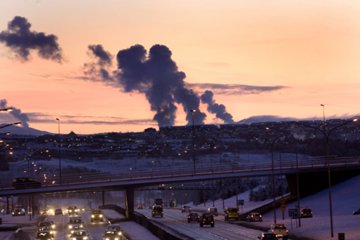
Since October 2006 Orkuveita Reykjavíkur (Reykjavík Energy) has produced geothermal energy on Hellisheiði, predominantly for the Norðurál/Century aluminium smelter in Grundartangi, Hvalfjörður. Since then increased sulphur pollution in the power plant’s surrounding area, as well as in the area around Reykjavík, has regularly become a topic of discussion and Sigurðardóttir says that the pollution’s impacts are systematically underestimated. Instead of using recent researches into the issue, Mannvit bases the EIA on prediction-models, but new studies by the University of Reykjavík indicate that the increased use of medicine for asthma and heart disease angina pectoris is directly linked to increased sulphur pollution. Read More
Jan 31 2011
4 Comments
Sigmundur Einarsson, a geologist at the Icelandic Institute of Natural History, has written some articles on this matter (in Icelandic). He has tried, amongst a number of other environmental scientists, to warn the Icelandic government about a new kind of collapse, an energy collapse due to following far too optimistic speculation of irresponsible people. Read More
Jul 13 2010
4 Comments
Join our resistance against the industrialization of Europe’s last remaining great wilderness and take direct action against heavy industry!
The Struggle So Far
The campaign to defend Europe’s greatest remaining wilderness continues. For the past five years summer direct action camps in Iceland have targeted aluminium smelters, mega-dams and geothermal power plants.
After the terrible destruction as a result of building Europe’s largest dam at Kárahnjúkar and massive geothermal plants at Hengill, there is still time to crush the ‘master plan’ that would have each major glacial river dammed, every substantial geothermal field exploited and the construction of aluminium smelters, an oil refinery, data farms and silicon factories. This would not only destroy unique landscapes and ecosystems but also lead to a massive increase in Iceland’s greenhouse gas emissions. Read More
Nov 17 2009
4 Comments
By Jaap Krater and Miriam Rose
In: Abrahamsky, K. (ed.) (2010) Sparking a World-wide Energy Revolution: Social Struggles in the Transition to a Post-Petrol World. AK Press, Edinburgh. p. 319-333
Iceland is developing its hydro and geothermal resources in the context of an energy master plan, mainly to provide power for expansion of the aluminium industry. This paper tests perceptions of geothermal energy as low-carbon, renewable and environmentally benign, using Icelandic geothermal industry as a case study.
The application of geothermal energy for aluminium smelting is discussed as well as environmental and human rights record of the aluminium industry in general. Despite application of renewable energy technologies, emission of greenhouse gases by aluminium production is set to increase.
Our analysis further shows that carbon emissions of geothermal installations can approximate those of gas-powered plants. In intensely exploited reservoirs, life of boreholes is limited and reservoirs need extensive recovery time after exploitation, making geothermal exploitation at these sites not renewable in the short to medium term. Pollution and landscape impacts are extensive when geothermal technology is applied on a large scale.
Krater and Rose – Development of Iceland’s Geothermal Energy – Download as PDF
The full publication will be available from Jan. 15, 2010. ISBN 9781849350051.
Oct 10 2009
1 Comment
From The Reykjavík Grapevine, by Catharine Fulton – One by one men in suits of varying shades of grey approached the podium in the pit of the Reykjavík City Hall. One by one they pleaded their cases while Reykjavík’s esteemed mayor—the fourth in two years—Ms. Hanna Birna Kristjánsdóttir looked on appearing disinterested in what appeared to be solely a formality. As the council members continued selling the idea of selling Iceland’s resources, a crowd of 100-strong grew more agitated and increasingly vocal from their perch in the viewing gallery of the hall, separated from having a say in their own natural resources by an aesthetically pleasing glass barrier.
“People were screaming, saying that the politicians were traitors,” explained Jón Bjarki Magnússon, a student who arrived at City Hall just in time for the vote. “It was a weird feeling to see it happen, to see these people down on the floor raise their hands and the decision is made and to see all these angry people above them not able to do anything.”
The September 15th city council meeting stretched on for over three hours, during which time onlookers shouted and boo-ed as city council progressed toward approving the 32.32% sale of Iceland’s HS Orka to the Canadian-cum-Swedish firm Magma Energy Corp. Read More
Aug 27 2009
Magma Energy, a Canadian company, wants to buy a majority share in H.S. Orka, a geothermal energy company based on the Reykjanes peninsula. In July this year Magma Energy bought a 11% share in H.S. Orka from Geysir Green Energy (GGE) and therefor became the first foreign shareholder in an Icelandic energy company. The purchase was a part of a bigger agreement between Reykjanesbær and GGE, which resulted in GGE owning a little more than 50% of H.S. Orka. Around the purchase, Ross Beaty, Magma’s director stated that the company did not plan to become predominant in H.S. Orka or meddle with the management of the company’s power plants.
In the middle of August, Orkuveita Reykjavíkur (O.R. – e. Reykjavík Energy) decided to start discussion with Magma Energy about the latter’s purchase of O.R.’s share in H.S. Orka, which is 32% and would therefor give Magma 43% share in the company and the possibility of increasing it 5%. Magma has bought the very small shares of the communities of Sandgerði and Hafnarfjörður, and has been discussing with communities like Vogar and Grindavík about buying their shares as well. If everything goes like planned, H.S. Orka, which e.g. is the biggest energy provider for the Century Aluminum’s planned smelter in Helguvík, will mostly be owned by to private companies; Magma and GGE, which will own c.a. half of the shares each. Read More
Apr 07 2009
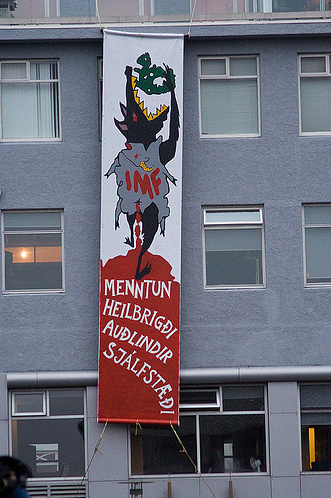
Perkins used to work for the U.S. National Security Agency and his job included “to convince poor countries to accept enormous development loans – and to make sure that such projects were contracted to U.S. companies,” as says on the back cover of his book. Perkins states that Iceland is the first ‘developed’ country in the world to be hit by the ‘Economic Hitmen’, referring to the invasion of the aluminium industry in Iceland. Read More
Mar 05 2009
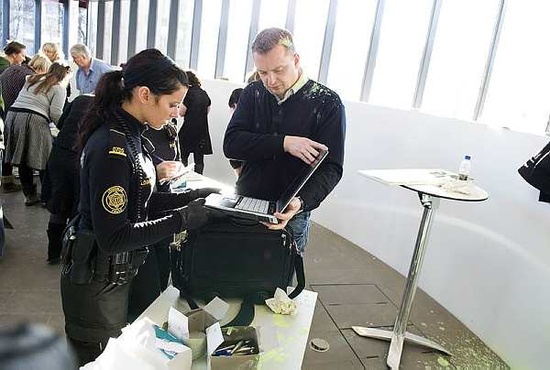
Gaia – the student association of Master students in Environment and Natural Resources, had organized a “Green Week” in the university. Among activities was this particular presentation by e.g. Landsvirkjun (Iceland’s national energy company), O.R. (Reykjavík Energy) and Geysir Green Energy; all companies who are involved in the development of the aluminium industry in Iceland. Read More
Feb 09 2009
From New Renaissance Magazine 
By Miriam Rose
The economic issues currently causing mass demonstrations in Iceland have a less publicised ecological cousin, and one which the IMF has recently identified as part of the economic collapse. In 1995 the Ministry of Industry and Landsvirkjun, the national power company, began to advertise Iceland’s huge hydropower and geothermal energy potential. In a brochure titled “Lowest energy prices!!” they offered the cheapest, most hard working and healthiest labour force in the world, the cleanest air and purest water – as well as the cheapest energy and “a minimum of environmental red tape” to some of the world’s most well known polluting industries and corporations (such as Rio Tinto and Alcoa). This campaigning has led to the development of an ‘Energy Master Plan’ aimed at damming almost all of the major glacial rivers in Iceland, and exploiting all of the geothermal energy, for the power intensive aluminium industry. The loans taken by the Icelandic state to build large scale energy projects, and the minimal payback they have received from the industry, has been a considerable contributing factor to the economic crisis, while at the same time creating a European ecological crisis that is little heard of.
The Largest Wilderness in Europe
I first visited Iceland in 2006 and spent a week with activists from the environmental campaign Saving Iceland, a network of individuals from around Europe and Iceland who decry the fragmentation of Europe’s largest wilderness in favour of heavy industry. From these informed and passionate folk I learned of the 690 MW Kárahnjúkar dam complex being built in the untouched Eastern Central Highlands to power one Alcoa aluminium smelter in a small fishing village called Reydarfjörður. The dams formed the largest hydro-power complex in Europe, and were set to drown 57 km2 of beautiful and virtually unstudied wilderness, the most fertile area in the surrounding highlands. Ultimately it would affect 3% of Iceland’s landmass with soil erosion and river silt deprivation. They also explained how materials in the glacial silt transported to the oceans bonds with atmospheric CO2, sinking carbon. The damming of Iceland’s glacial rivers not only decreases food supply for fish stocks in the North Atlantic, but also negatively impacts oceanic carbon absorption, a significant climatic effect. After taking part in demonstrations at the construction site of the Alcoa smelter (being built by famous Iraq war profiteers Bechtel), I went to see the area for myself. Read More