S.O.S.
STOP DESTRUCTION OF ICELAND!
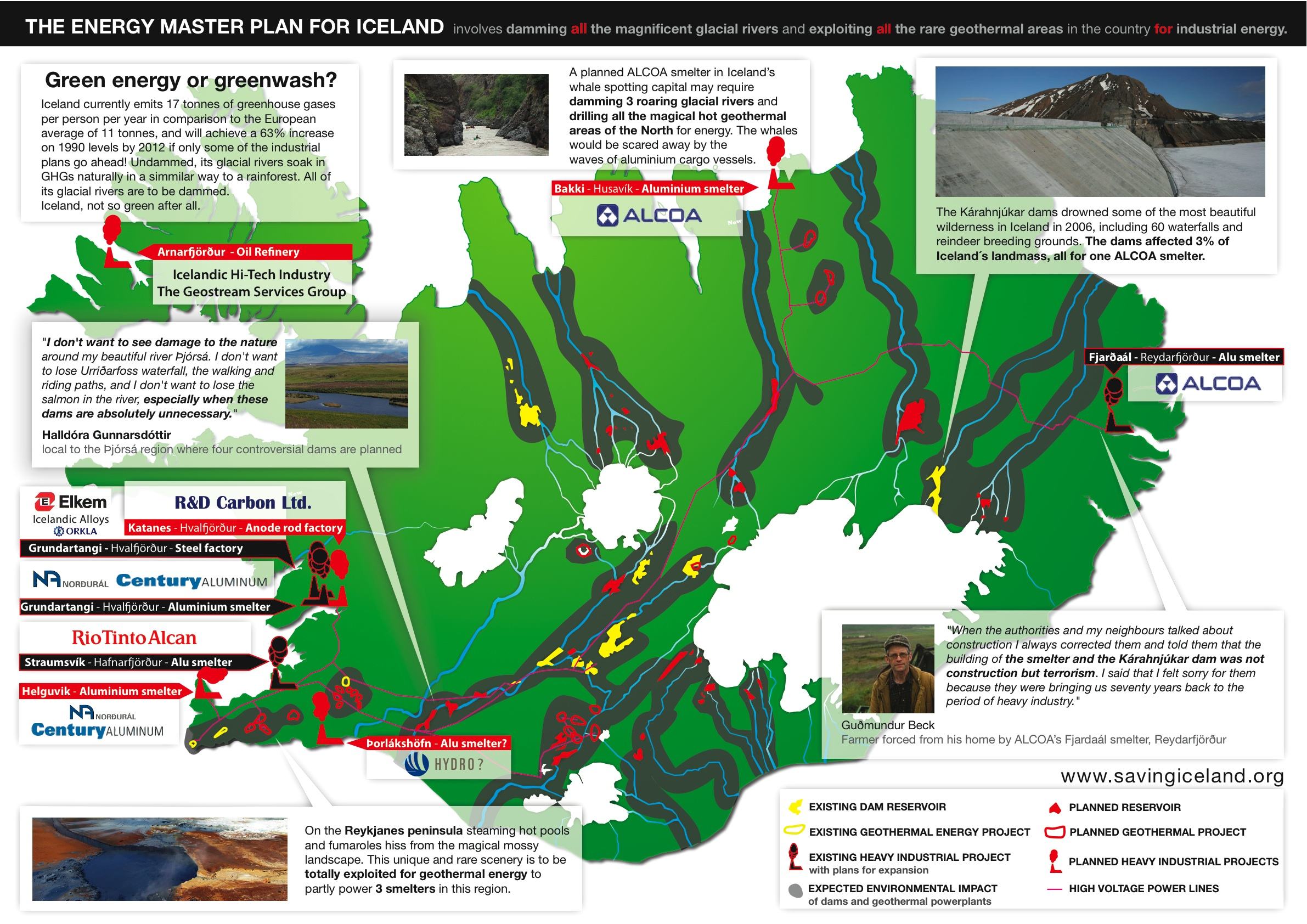
Stop the Icelandic government and arms manufacturers Alcoa, Rio Tinto Alcan and Century Aluminum destroying Europe’s largest remaining wilderness for aluminium plants! Stop the so-called ‘master plan’ to ‘develop’ Iceland’s beautiful nature into a heavy industry hell servicing the greed of aluminium corporations! It has already started. A whole world has been drowned in the eastern Icelandic highlands. But the Kárahnjúkar dam project is only the beginning of a much wider destruction. These multinational vandals – willingly helped by the Icelandic government – are about to produce an environmental catastrophe of unprecedented proportions. It is not too late to stop all the other energy projects that are in the pipeline and drive heavy industry out of Iceland!
Saving Iceland
Saving Iceland is an international campaign to defend the Icelandic Wilderness, the largest remaining wild area of Europe, from heavy industry. Different transnational companies, particularly the aluminium industry, and the Icelandic government have begun to implement an immense program that will, if executed, transform the country from an outstanding area of natural beauty into another heavily industrialised and polluted area.
Plans include the constructing of new smelters and expansion of existing ones, the harnessing of many of the countryï’s major glacial river systems and destruction of supreme geological geyser landscapes and unique geothermal biosystems for new power plants.
Corporations searching for cheap energy
Iceland, with its vast possibilities of hydroelectric and geothermal energy, is an appealing target for ALCOA, ALCAN, Century Aluminum and others, for two reasons. First is increasing energy insecurity and dependence and increased cost of utilising fossil fuels; second is the increasing concern about climate issues, where the green image of hydroelectric and geothermal energy is appealing. Also, Iceland has a comfortable amount of yet unspent carbon credits and the pollution prevention schemes are milder for the corporations. But Icelandic aluminium smelters will far exceed the 1,600,000 tonnes of emissions permitted under the Kyoto Convention if all of the planned smelter projects materialise. Aluminium contributes heavily to climate change, due to emission of large amounts of carbon dioxide and perfluorocarbons: potent, extremely persistent greenhouse agents, released in the electrolytic processing of bauxite.
Destruction of ecosystems
The ecological consequences of large dams are also grim. They include significant and irreversible loss of species, terrestrial and aquatic ecosystems. The massive alteration of major river systems around the world has led to more than a third of the species of sweet water fish to be extinct or endangered. The constantly fluctuating water levels in reservoirs in Iceland will cause dust storms and soil erosion, which will have a devastating effect on the vegetation of the region. It is estimated that up to 3000sq km will be affected by the dams at Kárahnjúkar alone.
Moreover, starving the marine life of the normal silt emissions would constitute a serious threat to the valuable Icelandic fishing grounds. A recent study shows that free flowing glacial rivers are vital in reducing greenhouse gasses in the atmosphere by providing nutrients to plankton and as such are already harnessed by nature. Blocking the silt emissions to the ocean nullifies this immensely beneficial role of glacial rivers.
Protests
Icelandic environmentalists are prepared for a battle that is certain to go on for many years. International help and pressure will be of paramount importance in that fight.
Summer solstice in 2005 saw the first international protest camp at Kárahnjúkar which marked the beginning of a highly inspirational and unique event in the history of Icelandic activism. The international protest camps last year (2006) at Snæfell, Lindur and Reyðarfjörður attracted people from 18 different nationalities. Best of all, summer 2006 saw many more Icelanders join the protests. We find that the camps and the direct actions of the last two summers have had a profound effect on Icelandic society by giving people the courage to make their voices heard after years of a repressive political atmosphere.
One of many effects the protests have had on the Icelandic nation is that people are now actually daring to change their minds about the dams. The protests have managed to get the heavy industry issue and its consequences back into focus. Many people working in the financial sector have now raised their voices against the projects, pointing out that the aluminium industry adds very little to the Icelandic economy. We have managed to create a fresh new focus and dialogue in Icelandic society about heavy industry.
Iceland is the last great expanse of truly unspoilt and magical wilderness left in Europe. It should really be a cause for celebration and wonder how pristine this strangely vibrant island still remains. The world cannot afford to allow beautiful Iceland to be devastated by corporate greed.
You people don´t know what you are talking about. Iceland´s nature is still there and this is in the economic interest of our country. Actually the road construction for the Karahnjukar dam opens up the highlands for nature lovers. It also brings economic development to the eastern part of the country and keeps the island evenly settled. This is important for our tourism.
Would you rather we open a new Sellafield nuclear power plant in Iceland? Please tend to your own garden. Any nation that produces nuclear power pollution, serial killers and mad cow disease has plenty of problems at home for its young radicals to occupy themselves with.
Please stay away from our country!
Concerned Icelandic citizen
It is true that this construction and activity in Iceland’s highlands is going to have major influence on the nature in that area. However, protestants woke up 3 years too late. Face it, it is too late to be stopped. Alot of the damage has already been done.
One question… are you Icelandic citizens or are you just not minding your own business??
Don’t trust alcoa and other large american based greedy companies.They’ll tell you what you want to hear and then do exactly what they want.Once they get their plant built and employees hired,they’ll play a new game.Go along with them and their policies or they’ll threaten to shut their plant down and put people out of work.The Icelandic landscape is too precious to be destroyed by money and greed.These corporations must be stopped.
It is not true that there has not been any protest against the Karahnjukar project until now. It has been fought hard against from the start. But this summer’s international protests are a new phase and a very important one that will have great repercusions.
First it was Eyjabakkar and we managed to save them. Now it is Karahnjukar and they will grind to a halt as the polticians and technocrats who are responsible will drown in the consequences of their own corruption and stupidity.
Next it will be Thjorsarver and Langisjor and we will stop them too.
aagh, guess it’s all on then… the big biz aren’t even trying to be subtle now are they?
any ideas for solidarity actions for those who can’t/don’t want to fly to your aid?
from Aotearoa/New Zealand
It´s funny that some people think that we can’t build a road unless we build a huge dam and aluminium smelter also. Let´s say the road was a good thing to “open up the highlands” for people. Pretty dam expencive road that was. This area has always been open… for people who really enjoy staying in nature, taking a hike and look at it, not only through their cars windows but actually feeling it!
We don´t need more power, that´s the point. We waste power now and if we would use it more wisely, we would have more than enough. We are giving the power away to the aluminium factories, Ipregilo pays so low that almost no Icelander works up there. We will loose money on this project, not gain money. It´s causing inflation and making companies elsewere in Iceland go bankrupt. It´s a short term solution. We are too lazy to think of any real solutions.
Someone metioned that the protests are comming too late, that´s not right. Cause if no one does anything they will continue on and on.
I´m proud of my land… and I want to be able to see it, not just photograps of land that used to be.
Im Icelandic and welcome all protestors here-you should definetly stand up for what you believe to be right and no matter where in the world anyone is from this sort of thing concerns everyone. Building this dam is a huge mistake. It will not do anything for the economy at all-there is no proof of that and if things go the way they are now it might actually turn out to undermine Icelandic companies. Alcoa was made to pay the highest ever settlement or fine ever in history for a specific type of pollution rule-break. They are definetly not to be trusted. Aside from people not getting paid and living in bad conditions at the karahnjukar area- which i hear has improved- more than 70% of the workforce there is foreign. Icelanders are not getting the better end of the deal- neither is the world for that matter. If there would be an earthquake or volcanic eruption resulting in flooding this would certainly all go to hell- yet there is still time to stop this. People have no idea what they are doing up there and the consequences will be seen for decades to come-when later generations will have to clean up this mess-which they will.
Greed is the killer
have you ever thought about the people who need jobs to support there familys in ice land? this will totally change there economy for the better. are you concerned about mother earth? it was here long before we were and will be here when we are gone. we are very a very small part of the earth’s natural cycle.did you know that one volcano destroys more o-zone layer than man has done since he has been here? think and reserch the true facts before you protest.
[A letter to SavingIceland]
Good morning,
I am very much against this project too.
This project is not about providing cheap energy for industry, it is about creating a civil engineering monument which will become a “white elephant”.
We all know that the energy could have been provided much more easily and quickly by bore holes, as has been recently proved once again in the Reykjanes peninsula. But, the Icelandic government wants this grand civil engineering project instead ! I have also heard recently that the tunnels they are boring through the mountains to provide the drain off’s to the generators have hit problems due to the strata along a fault line. This has meant that they can no longer tunnel in the impervious layer and are now having to concrete ahead of the tunnelling machine to provide an impervious layer!!! This means that the tunnel is going to be very much delayed and much more expensive and who will pick up the bill? It will be the Icelandic home owners whose electricity bills will soar in cost.
What this shows is not only did Impregilo or Landsvirkjun not carry out a full environmental impact assessment, they also did not carry out a full geological survey.
The poor Icelandic people will be paying for this blunder for many
many years, you have my sympathy and support.
Kind regards,
Malcolm.
A lot of people are from all over the world.
Your comment sounds nationalistic and personally I think it’s quiete narrow minded to think that nature only belongs to one country.
Nature belongs to all, and if the project in Iceland goes along, it will have an impact on global warming which has an impact on everyone, no matter where you are from.
People involved in these protests are trying to do something positive and are working very hard and on a voluntary basis!!!!
START THINKING OUTSIDE THE BOX!
can’t we try to save at least ONE place on this earth?
i have been following the discussion about the building of the aluminium smelter in iceland for a little while and as much as it MIGHT offer job perspectives and progress for iceland’s economy i do not see a reason to support this project.
from a foreign view (as i am not an icelander) i must say that to me iceland has always been THE country because it seemed one of the last natural paradises on this planet. it is a piece of earth that is still growing…like a child. so why would anyone want to poison it? if we continue being selfish and rob all the goods from nature what is there left for following generations? we cannot be as narrowminded as to only think of ourselves and maybe 20 years ahead…
in contrast to the majority of other countries all over the world iceland is one place where environmental catastrophes can still be prevented instead. due to the progress in industries, science etc many countries have paid high prices to reduce pollution and destruction of whole landscapes. and there is no way to recreate the beauty that has been lost so far. don’t let this happen to iceland!
also iceland’s importance in terms of tourism is constantly growing and its greatest thing to offer to the visitors is its incredible and breathtaking nature. what will be there to experience for them once there are smelters everywhere that destroy the peace and beauty?
and what about the icelanders themselves? from my experience they adore to leave the city at the weekends and spend their time close to nature and with it. how can it be that there are still those who do not see what damage they will do to the country(side)?
i wish that the prostest gathering in july and the prostest in general will make people more aware of the fatal consequences a smelter would bring. and i wish to be able to come back to iceland and enjoy its beauty, peace and open space as i have done before knowing it will be there for a long long time.
I have – with increasing concern and interest – followed some of the discussions on this site, as well as other places.
I have been at Karahnjukar. Not just at the tourist-spot, but in the tunnels, at the site, in the buildings.
I must admit, that the sheer size left me dumbfounded. Nature wise I can understand why so many people protest against the flodding etc. and I cannot understand why anybody (sane) would say YES to this in the first place.
This being said I must say… I feel there is nothing left to do about the dam. The cost is already sky high and I do not think anybody dare to stop that part of the project. Only a minor catastrophe could probably stop the powerplant from getting the water it needs.
I think the main focus should be on the aluminium plant for now and henceforth. THAT is the main killer. If that is stopped, the dam and powerplant is of no use and it will have a huge effect on… people, economy, government and everybody involved.
It may be, that I do not (yet) understand all aspects of this, but I am continuously looking into it. If you have links to ressources I should know about, please let me know. (And I do read Icelandic…)
What a marvelous site. We are very impressed.
There are many of us in Iceland who do not participate directly in this fight – and a fight it is – but we are grateful to those who do.
So please, keep up the good work.
Helga, Iceland
[Submited by e-mail. Ed.]
Entirely wrong is the only way to describe this.
From all the photography I have seen of Iceland, I was blown away. So amazed by the beauty of it all that I was considering moving to Iceland around 2010, mainly because of the natural beauty.
I would completely change my mind if these plans are taken into full effect, there aren’t many places like Iceland – it truly is a work of art. It’s just enough to show you the stunning things the Earth can produce. That is one thing I feel nobody should be able to take away.
Please don’t destroy one of the only beautiful countries left with so much to offer. It would destroy many people who sit looking at pictures late at night wishing for a place that one day they can call their home.
Our band has written a song about Iceland .. If you’d like to hear it or use it for the cause…
http://www.myspace.com/thedeepsite
You talk about the facts, Eric, but the facts are plentyfull on this website and elsewhere and they all show that this stupid project is NOT creating jobs for Icelanders. In fact 90% of the workers building the dam are cheap foreign labour who are treated worse than animals by Impregilo and the greedy Icelanders.
It is the same with the Bechtel built ALCOA smelter. Polish workers are building the smelter!
ALCOA have had to announce, when it became apparent that Icelanders do NOT want to work in the smelter once it is built, that they will hire FOREIGN WORKERS to work in the smelter.
Eric, get your facts right, otherwise you are full of shit!
Heavy Industry in Iceland must be stopped. Iceland is considered the most developed nation in the world, with the highest life expectancy and the lowest unemployment. There is a chronic labor shortage in Iceland, and an energy surplus. These aluminum companies are heavily subsidized and will bring nothing but heartache to Iceland. They will destroy some of the last pristine wilderness in Europe and forever tarnish Iceland’s international reputation as a progressive, environmentally advanced nation. People of Iceland! Resist! Tell your government to stop making deals with corporations that have no loyalty whatsoever to Iceland or its people, the activists who come there to work on this campaign are for more concerned for your well being than the corporations you defend. Saving Iceland- we send solidarity from New York City. You are heroes.
Please!
i write from switzerland, beautiful country they say! plenty of tourist everywhere and i can tell you it once started like in iceland, for the economic developpment, only one road then another, there is no place now where you can walk more than 10 minutes without seeing a hightension tower, a road. everything is under “human” control, nature in switzerland doen’t exist anymore, it is still beautiful ok, but it has not what you still have in icland, those places where we don’t see the traces of man, where nature is real and alive.
This beauty has no price and once it’s over, it’s over, you can’t buy it back.
don’t let your government destroy the most you have for money!!!
Come, see, look pictures, switzerland is the result of tourism industry, nothing is natural, ok it’s nice but it has lost its authenticity.
you still have it in Icland! Take care of it, please!!! there are so few places in the world like this!
Don’t be blinded by money
As a citizen of planet Earth I am amazed that any person would sanction this destruction and irretrievable mess without good cause.
[…] S.O.S. […]
[…] C.) Fyrir frekari upplýsingar um áætlaðar stóriðjuframkvæmdir á Íslandi, sjá: https://www.savingiceland.org/sos […]