'Economics'
Tag Archive
Aug 27 2009
Alterra Power/Magma Energy, Economics, Geysir Green Energy, H.S. Orka, Helguvík, IMF, Reykjavik Energy
Magma Energy, a Canadian company, wants to buy a majority share in H.S. Orka, a geothermal energy company based on the Reykjanes peninsula. In July this year Magma Energy bought a 11% share in H.S. Orka from Geysir Green Energy (GGE) and therefor became the first foreign shareholder in an Icelandic energy company. The purchase was a part of a bigger agreement between Reykjanesbær and GGE, which resulted in GGE owning a little more than 50% of H.S. Orka. Around the purchase, Ross Beaty, Magma’s director stated that the company did not plan to become predominant in H.S. Orka or meddle with the management of the company’s power plants.
In the middle of August, Orkuveita Reykjavíkur (O.R. – e. Reykjavík Energy) decided to start discussion with Magma Energy about the latter’s purchase of O.R.’s share in H.S. Orka, which is 32% and would therefor give Magma 43% share in the company and the possibility of increasing it 5%. Magma has bought the very small shares of the communities of Sandgerði and Hafnarfjörður, and has been discussing with communities like Vogar and Grindavík about buying their shares as well. If everything goes like planned, H.S. Orka, which e.g. is the biggest energy provider for the Century Aluminum’s planned smelter in Helguvík, will mostly be owned by to private companies; Magma and GGE, which will own c.a. half of the shares each. Read More
Aug 08 2009
Actions, Century Aluminum, Corruption, Economics, Landsvirkjun, Laws, Media bias, Repression, Saving Iceland
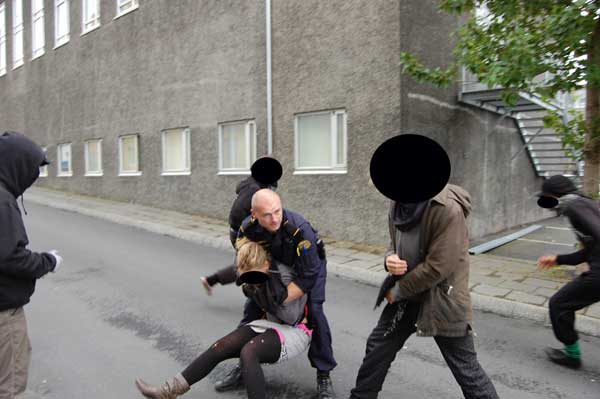
Yesterday, Friday August 7th, Saving Iceland protested by the Ministry of Industry. At the same time inside the building, a financial contract was signed between the
government and Norðurál/Century Aluminum, concerning the latter’s smelter in Helguvík. When the protest was about to end, the police showed up, arrested 5 individuals and aggressively roughed up one of them. Most of the media has spoken about the event but not mentioned the police brutality at all. Instead, the media has unsparingly published the police’s smear about us: that a policeman was kicked in the head and that we threatened the police with iron sticks, without any evidence showing that anything like this ever took place. Saving Iceland rejects these accusations and renounces the media’s one-sided reports.
The contract that was signed today includes state support for the aluminium smelters in the form of a tax discount that amounts to 16,2 million US dollars – two billion Icelandic krónur – and gives Norðurál/Century exemptions from paying industry fees, market fees and electricity safety fees. Special rules will also apply concerning stamp duty and planning fees, and about new taxes. The emission permits that are now valid permit a 150 thousand ton smelter in Helguvík; the Environmental Impact Assessment permits 250 thousand tons, but Century/Norðurál plans to build a 360 thousand ton smelter and today’s contract gives the company the right to do so. (1) The energy for the smelter has not been found and Svandís Svarvarsdóttir, the minister of environment has officially said that enough energy to run the smelter does not exist in the Reykjanes peninsula. At the same time, Katrín Júlíusdóttir, the minister of industry, has agreed with ideas about Landsvirkjun selling energy from the planned dams in Þjórsá river to Helguvík. (3) Read More
Jul 29 2009
ALCOA, Andri Snaer Magnason, Century Aluminum, Economics, Landsvirkjun, Saving Iceland, Þjórsá
Shortly after the news about how Saving Iceland closed the offices of institutions and companies involved in the heavy industrialization of Iceland, Katrín Júlíusdóttir, the Minister of Industry said that she had not been able to study the message of Saving Iceland. She said that she had not received a written report from the group and not decided to contact it, but said that she takes a look at all factual comments that she receives. (1)
This is a typical answer for a politician or a corporation’s worker when his/her job is criticized. It is impossible to keep track of how many times Saving Iceland has been offered to sit down and chat with the spokespersons of companies like Landsvirkjun (Iceland’s national energy company) and political parties’ representatives. The purpose with these invitations to meetings is of course only to create a positive image of the corporation or the institution and give the idea that conversation and information are necessary parts of the business. When Saving Iceland has refused these offers, the movement has been stamped as non-factual and with a lack of knowledge, e.g. last summer when Landsvirkjun’s director, Friðrik Sophusson said the Saving Iceland was only asking for attention by acting like clowns. (2)
Katrín Júlíusdóttir knows just as well as Friðrik Sophusson what Saving Iceland’s message and aims are, and thus does not have to ask herself why the group did not wish to meet up with her. Environmentalists in Iceland – including Saving Iceland – have for years explained their resistance towards the heavy industrialization of Iceland with powerful information campaigns, publishing magazines and pamphlets, keeping up websites etc. etc. Most of Saving Iceland’s actions have been followed up with comprehensive press releases, including inconvenient facts about the companies that have to do with the heavy industrialization and information about the serious effects of aluminium production. These press releases have e.g. lead to the fact that the media coverage about the issue has widened. An example of that is the media coverage on the effects of bauxite mining and the aluminium companies’ connection and co-operation with arms producers and war institutions. (3) Read More
Jul 08 2009
Economics, Landsvirkjun
The company Standards and Poors, which evaluates company’s credit rating, has lowered Landsvirkjun (Iceland’s national energy company) down to a category usually known as “the Trash”, due to Landsvirkjun’s constantly worsening financial situation. This means e.g. that the company will face serious problems when trying to get loans for new and upcoming projects. In announcement from Landsvirkjun, Stefán Pétursson, the company’s financial director, says that the lowered position will not have any impacts on the company’s already existing loans.
This is for the first time when Landsvirkjun’s credit rate is lower then the Icelandic state’s rate. According to Bloomberg, Landsvirkjun has to pay 250 million dollars (32 billion ISK) this year and the next one, as payments of loans and bonds, as well as paying interests.
The 19th of June this year, Landsvirkjun and the Icelandic state signed a contract, which states that if Landsvirkjun is in a lack of finance to pay their costs because of loans, the Central Bank will give the company money in exchange of Icelandic Krónur or bonds. The contract is valid for two years and with it, Landsvirkjun has access to 300 million dollars.
Jul 08 2009
Century Aluminum, Economics
On Tuesday June 16th, Svandís Svavarsdóttir, Iceland’s new minister of environment, said in parliament that the needed 625 MW of energy needed for Century’s (Norðurál) aluminium smelter in Helguvík, does not exist.
“I could hold long speeches about it, that 625 MW for 365 thousand ton aluminium smelter, does not exist in this area. At the same time we are trying to discuss with people who knock on our doors, people who want green jobs and green build-up and we cannot promise them energy because the energy is mostly narrowed to aluminium production. Unfortunately. It is very serious case”, said Svandís. Read More
May 10 2009
ALCOA, Andri Snaer Magnason, Corruption, Economics, Landsvirkjun, Saving Iceland
Given the chance, we’d have made it into Murmansk
From The Reykjavík Grapvine – Dreamland is the result of collaboration between documentary filmmaker Þorfinnur Guðnason and author, playwright and poet Andri Snær Magnason. It is based on the latter’s best selling, award winning 2006 non-fiction book, ‘Dreamland: A self-help manual for a Frightened Nation’ (available in English translation through Amazon.co.uk and at local bookstores). The book stirred a lot of controversy in Iceland, as it shed new light on some of the issues surrounding the conflict between environmental preservation and the build up of heavy industry in Iceland. It furthermore examined the government’s hope to sell cheap energy from hydroelectric power plants in order to place Iceland among the world’s biggest aluminium manufacturers – and why on Earth we’d aspire to that.
The film goes even further, using the full potential of the medium to conjure up a truly chilling vision of recent events. And it’s effective. As we exited a screening of the film, my friend Geiri summarised the experience perfectly, saying: “Most of the time, I didn’t know whether to laugh, cry or vomit in disgust.” That somehow says it all. A scathing indictment of Iceland’s recent “all in” industrial and environmental policies, Dreamland combines archival news footage, exquisite nature shots and select interviews to achieve its goal of waking Icelanders up to the very real, very serious consequences of selling off some of the last bits of pristine wilderness remaining in Europe. Read More
Apr 25 2009
Actions, ALCOA, Century Aluminum, Corruption, Democracy deficit, Economic Collapse, Economics, Greenwash, Kárahnjúkar, Landsvirkjun, Media bias, Ólafur Páll Sigurdsson, Rio Tinto Alcan, Saving Iceland
Olafur Pall Sigurdsson
Saving Iceland applauds the symbolic hits that the three pro-heavy industry political parties were dealt in the form of liberal splashes of green skyr (traditional Icelandic dairy product) on Monday.
According to Saving Iceland’s sources, three different groups, not just one, like the corporate media have claimed, did these actions almost simultaneously. Saving Iceland has also been informed that the activists were all Icelandic. It appears that this is a powerful group of activists, fighting the heavy industrialization of Iceland. Saving Iceland declares full support with the group.
The forces that stand behind Sjálfstæðisflokkurinn (Conservatives), Framsóknarflokkurinn (Right-wing opportunists) and Samfylkingin (New Labour equivalents), are guilty of what is tantamount to high treason with their heavy industry policy. Judging from their election propaganda, there is no sign that the parties have been willing to learn anything from the economic collapse about the expansion effects on the economy by heavy industry.
At the same time as these parties’ policy of uncontrollable greed has been pursued with the consequences of immense irreversible destruction of the country’s unique nature, this policy has just as much harmed Icelandic society as a whole. Read More
Apr 07 2009
ALCOA, Alterra Power/Magma Energy, Andri Snaer Magnason, Century Aluminum, Corruption, Democracy deficit, Economic Collapse, Economics, Energy Prices, Geothermal Energy, Jaap Krater, Kárahnjúkar, Landsvirkjun, Reykjavik Energy, Rio Tinto Alcan, Saving Iceland
John Perkins, the author of
The Confessions of an Economic Hitman, is currently in Iceland. Perkins is here to be at the premier screening of
The Dreamland, a documentary based on Andri Snær Magnason’s book, also titled
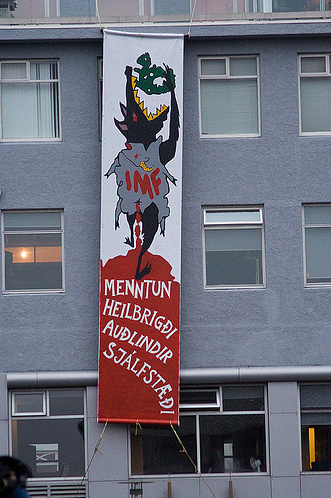
The Dreamland. Last Sunday, Perkins was interviewed in a political TV show on RÚV (the state television station) where he spoke about the threat of Icelandic resources being sold to foreign corporations and advised Icelandic authorities not to collaborate with the International Monetary Fund (IMF).
Perkins used to work for the U.S. National Security Agency and his job included “to convince poor countries to accept enormous development loans – and to make sure that such projects were contracted to U.S. companies,” as says on the back cover of his book. Perkins states that Iceland is the first ‘developed’ country in the world to be hit by the ‘Economic Hitmen’, referring to the invasion of the aluminium industry in Iceland. Read More
Dec 18 2008
Economics, Landsvirkjun, Rio Tinto Alcan, Tungnaá
The construction of Búðarháls Dam (Búðarhálsvirkjun) in Tungnaá river, will probably be further delayed due to the uncertain future of Landsvirkjun´s financial possibilities. Landsvirkjun is Iceland’s national energy company. The construction was originally supposed to start early next year, after being delayed since 2003. The estimated cost is 25 billion Icelandic krónur.
Because of the collapse of the Icelandic banks and the international financial crisis, most possibilities for foreign loans are now frozen. Landsvirkjun’s long time financement is therefore quite uncertain.
“This mostly impacts new constructions, like Búðarhálsvirkjun” says Þorsteinn Hilmarsson, Landsvirkjun’s PR manager. “It is necessary to insure the future financement before the construction starts. ”
Read More
Dec 18 2008
Economics
Bloomberg – Iceland’s planned economic recovery, based on raising exports of aluminum, may take longer to achieve than the government expects as the global slowdown forces down commodity prices, Fitch Ratings said.
The island is relying on aluminum sales, which have overtaken marine exports as its biggest export, to pull it out of the worst recession in more than half a century. The metal made up about 40 percent of total exports in the first 10 months, compared with 27 percent a year earlier, according to the statistics agency. Still, increased reliance on aluminum comes at a bad time as prices have slumped more than 30 percent since the start of the year.
Read More