Home

Threatened Areas

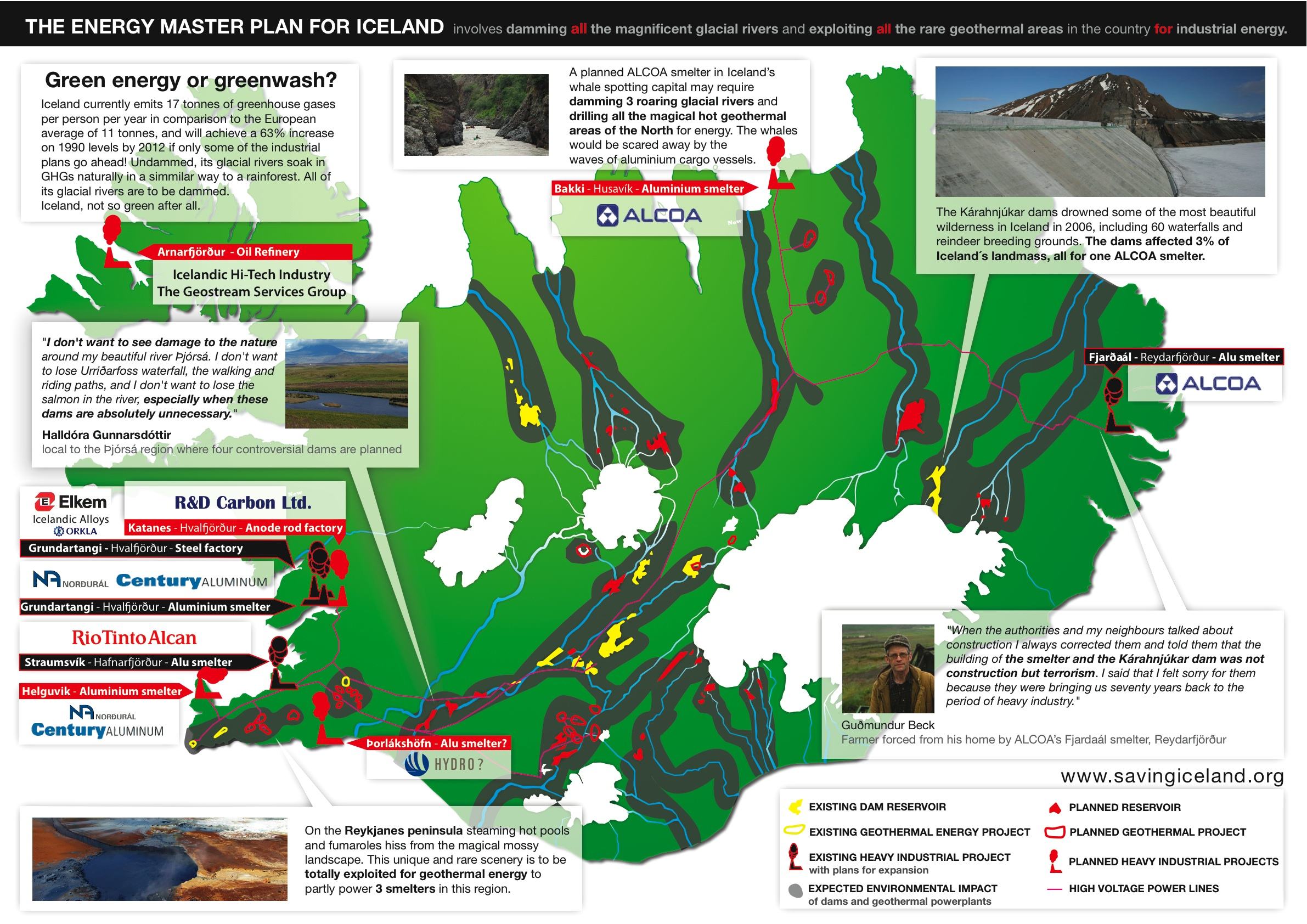
Dams and geothermal sites in Iceland in 2006 –
and onwards, if the government's plans will be
abandoned in time.
Maps image upload
Iceland in 2020, if the government's promises of
energy production for heavy industry are to be
delivered. All major glacial rivers in Iceland must
be harnessed in accordance with Master Plan,
phase 1.
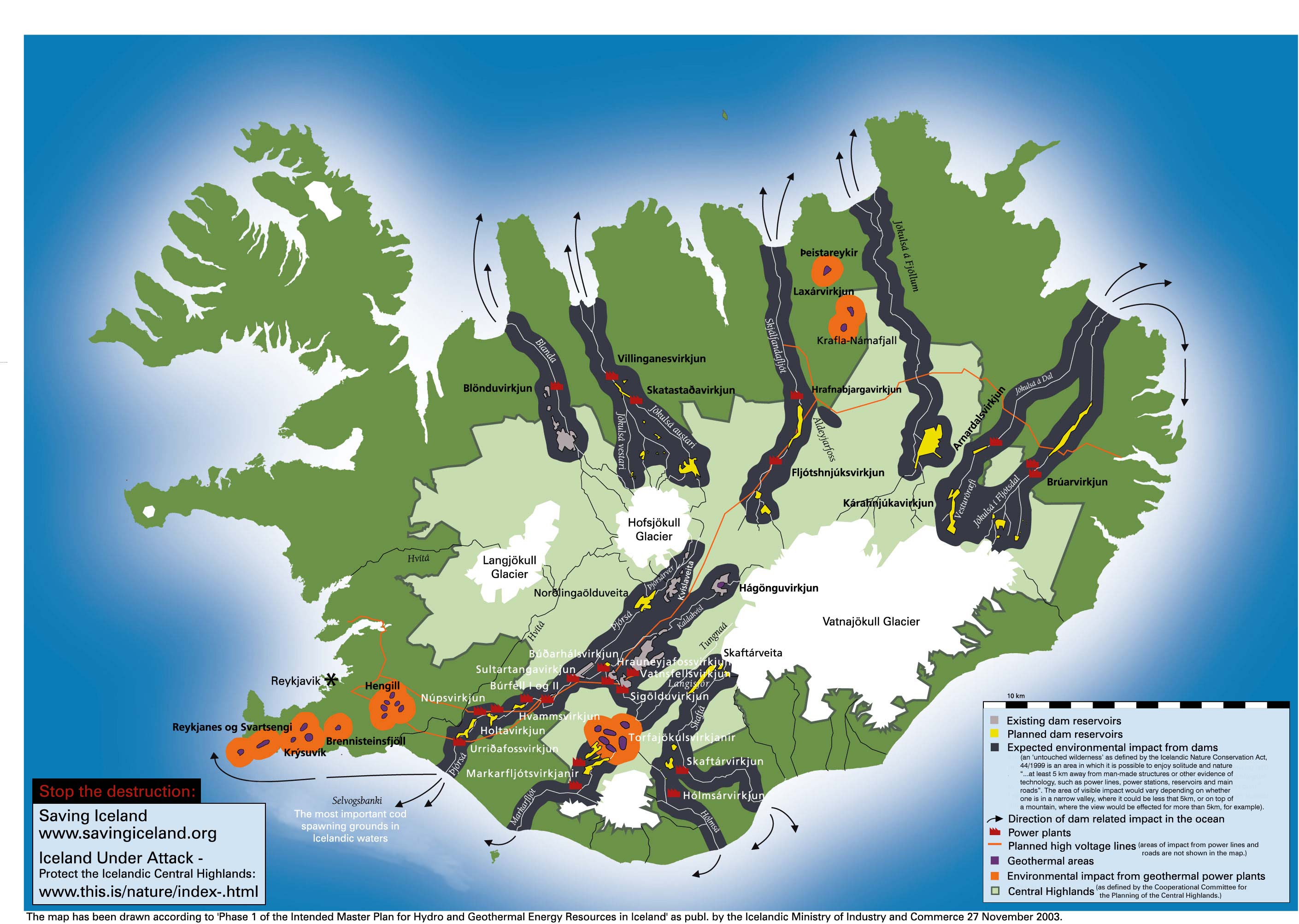
Maps image upload

Click here for the map of the "The Intended Master Plan" with English legend (text version)

Power schemes in master plan for hydro and geothermal energy resources in Iceland
Master Plan: Hydro Power Schemes (Vatnsorkukostir - In Icelandic)

Master Plan: Geothermal Power Schemes (Jarðhitakostir - In Icelandic)

Maps of: power options, hydro power options, Geothermal Energy in Iceland

Energy use and energy resources (Icelandic version includes a list of potential future developments)

Areas threatened by the construction of aluminium plants:

Multimedia Resources
Iceland's globalisation: Iceland's destruction - Click image to enlarge
.

Reydarfjordur (Alcoa plant - almost ready)

[ALCOA] Aluminium Plant in North Iceland - Comparison Study - HRV Engineering - January 2006

Husavik/Akureyri/Sauðárkrókur (Alcoa have now singled out Husavik but these were the options for a plant by 2010)

Helguvík, west of Keflavik (proposed new Norðurál/Century Aluminium plant, supposedly to be in operation between 2010-2015)

Grundartangi, Hvalfjörður (enlargement of the Norðurál/Century Aluminium plant is already underway)

UPDATED!! Powerpoint show of some of the areas endangered by the aluminium industry

RIVER THJORSA (ÞJÓRSÁ)

Thjorsa arial

Under severe threat from Landsvirkjun, the National Power Company.

The river Thjorsa is the longest and the second most voluminous river of the country (364 m³/sec.). It is 230 km (139 miles) long and succeeds river Olfusa by volume (373 m³/sec.). It is the natural border between the districts Rangarvellir- and Arnessysla with its northernmost tributary called The Spring Fed River.

The source of the river is situated a mere 70 km (42 miles) south of the end of the Eyjafjord bay in the North. The main course of the river is towards southwest, following the main tectonic fissure system of the country. The discharge area covers about 7530 km² and most its volume is run off water from the glaciers Vatnajokull and Hofsjokull. The greatest floods measured, which took place in 1948 and 1949, exceeded 3000 m³/sec. The river sometimes, but rarely, almost disappears for a while in the lower regions of its course, when the winter ice breaks up and creates natural dams.

The river transports a great volume of silt and gravel from the erosion areas of the central highlands, about 4,5 million tons per year. Some of the most beautiful waterfalls in Iceland adorn the river on its way to the ocean. Its largest tributary, which is larger than the Thjorsa River itself at the confluence, is Tungnaa.

River Thjorsa and its tributaries represent about 27% of the hydropower of the country. There are several man made reservoirs in the central highlands to secure supply of water for the several existing power stations in the river the whole year round. These projects have already impaired the ecosystem of Thjorsa and its crucial role in feeding the major cod spawning grounds of Iceland.

Seals have rookeries in the estuaries of the river. Salmon, trout and char migrate upriver every summer and autumn and head for the spring fed- or the run off tributaries to spawn. Any further damming of this vital force of life will seriously damage one of Iceland's most important ecosystems.

Thjorsa Earthquake Zone:
Report in pdf by renowned geologist Páll Einarsson that shows the Thjorsa river basin to have earthquake faults, making it very unstable for the planned dams and risking the lives of those who live nearby. (In English and Icelandic)

The threat to the salmon stock posed by damming Urridafoss (only in Icelandic):
Skýrsla Dr. Ragnhildar Sigurðardóttur um umhverfisáhrif Urriðarfossvirkjunar og hættuna á eyðileggingu laxastofns Þjórsár.

'Stóra samhengið' eftir Guðmund Pál Ólafsson náttúrufræðing
Virkjanaæði stjórnvalda stefnir fiskimiðum landsins í voða

'Þegar vorið vaknar...' ávarp Guðmundar Páls Ólafssonar
Ávarpið var flutt á baráttufundi gegn virkjunum í Neðri-Þjórsá 17. febrúar 2008.

'Frá sigri til Sigurs' ávarp Birgirs Sigurðssonar
Ávarpið var flutt á baráttufundi gegn virkjunum í Neðri-Þjórsá 17. febrúar 2008.

Thjorsa - rural

disney falls

Dynkur falls in Thjorsa
Dynkur

Urridafoss - Photo by Siggi Geirs
Urridafoss falls - Photo by Siggi Geirs

River Þjórsá in winter

Thjorsa

HENGILL VOLCANO & THINGVELLIR NATIONAL PARK

Map of powerprojects in the area of Hengill volcano

Hengill is an active volcano in southwest Iceland close to Hveragerdi and Reykjavik. The mountain and the systems of valleys around it host numerous geothermal fields and some of the most beautiful hiking spots close to the capital. In Icelandic this area is often referred to as "Hengilssvæðið". Reykjavik Energy (Orkuveita Reykjavikur) have already heavily vandalized parts of the Hengill area in order to provide geothermal energy (Hellisheidarvirkjun power plant on the southern slopes and Nesjavallavirkjun plant on the northern slopes) for an enlargement of the Century Aluminum smelter in Hvalfjordur. Now they want to do more damage (Bitru and Hverahlidar plants) to the Hengill area to provide energy for new smelters for Century Aluminum and Rio Tinto-ALCAN. The Nesjavalla plant is now suspected by the The Environment Agency of Iceland for having poisoned Lake Thingvallavatn with mercury. A recent pan-Nordic study shows large sea-trout in Thingvallavatn to carry mercury above set safety levels.

The Thingvellir National Park is a UNESCO World Heritage Site and that includes Lake Thingvallavatn. Thingvellir and Thingvallavatn are now also threatened by a motorway scheme on the eastern side of the lake. UNESCO have issued a statement that they will withdraw the World Heritage status of Thingvellir if plans for this motorway are not stopped.

Nothing seems to be safe from the 21st Century armies of Icelandic bulldozers.

Hengill/Hellisheidarvirkjun
Hengill volcano and Hellisheidi plant. Just the beginning?

Since the Hellisheidi plant was commissioned metal objects in the capital have been turning black because of the sulphur pollution. Scientists have calculated that if the additional geothermal power plants in the Hengill region will be completed the resulting pollution will amount to that of a large aluminium smelter.

The photographs from the Hengill region below are from a new Icelandic website devoted to save the area from Reykjavik Energy and heavy industry: The Future of the Hengill Area - Do We Want a Hiking Paradise or an Industrial Zone?

Hengill9
Hengill8
Hengill7
Hengill6
Hengill3
Hengill2
Hengill1

BRENNISTEINSFJÖLL & KRÍSUVÍK

This is a pristine range of mountains and massive geothermal fields on the Reykjanes peninsula (close to Reykjavík.) The geothermal fields are targeted by Century Aluminum for a new smelter in Helguvík. Geologists and environmentalists have a plan to make the area an international volcano park. If the smelter in Helguvik will go ahead the area will be devastated by geothermal plants and nothing will come of the volcano park.

Krýsuvík2
Krýsuvík3
Seltun
Brennisteinsfjöll1
Lake Kleifarvatn in the background
Brennisteinsfjöll2
Brennisteinsfjöll3
Brennisteinsfjoll

EYJABAKKAR - JÖKULSÁ Í FLJÓTSDAL

Eyjabakkar6

Eyjabakkar are east of Kárahnjúkar / Jökulsá á Brú and Mnt. Snæfell. They are the second largest wetlands in the Icelandic highlands (only Thjórsárver are larger) with a huge population of pink footed geese and other bird species. Public outcry put a stop to plans for massive dams that would have completely destroyed Eyjabakkar. Now, as part of the Kárahnjúkar project, dams are being built on the fringes of Eyjabakkar in order to destroy a second major glacial river for ALCOA, Jökulsá í Fljótsdal. A series of beautiful waterfalls will vanish. Landsvirkjun have cunningly designed the dams so that they are easily modified to drown the whole of Eyjabakkar to provide power for a possible future expansion of the ALCOA smelter in Reydarfjördur.

Jokulsarveita

Eyjabakkar4

Folavatn
Folavatn

Eyjabakkar2

Eyjabakkar3
geese

Eyjabakkar

LANGISJÓR

langisj

Langisjór is one of Europe's most beautiful lakes (at the western edge of Vatnajökull) - Targeted for destruction as "Skaftárveita" by the National Power Company (Landsvirkjun,) and RIO TINTO-ALCAN.

Langisjór and its surroundings were excluded by the last government from a protection scheme (Vatnajökull National Park) to make it easier to destroy in the near future. Now the government have made a declaration that they want to protect Langisjór. However, Langisjór has not been included in the 'Vatnajökull National Park'. If Landsvirkjun get away with forcing the three dams in lower Thjorsá upon the rural communities in the area they will almost certainly claim that they need to destroy both Thjórsárver and Langisjór to provide enough water for the three dams in Thjórsá. Landsvirkjun have already started doing "tests" and building infrastructure in the area.

Haukur Snorrason
Haukur Snorrason2
rut hallgrimsdottir
anna fjola gisladottir

Langisjor7

Threatened AreasClick image for large

KERLINGARFJÖLL

kerlingarfjöll2

A pristine range of mountains with geothermal areas targeted by Reykjavík Energy for Rio Tinto-ALCAN and Century Aluminum. South west of Hofsjökull glacier.

kerlingarfjöll

THJÓRSÁRVER - Click here for atricle

Mulajökull

'The Heart of Iceland' - Thjórsárver (South of Hofsjokull), even if listed by the international treaty of Ramsar as one of the most important wetlands in the world, Thjórsárver are on RIO TINTO-ALCAN's and Landsvirkjun's hit list.

thjorsarver3
tjver air
LInks
peace2

SKJÁLFANDAFLJÓT

upload images
Aldeyjarfoss

In the river of Skjálfandafljót (North Iceland) are the magnificent waterfalls Aldeyjarfoss, Hrafnabjargafoss and Goðafoss. Targeted for the future expansion of the proposed ALCOA smelter at Húsavík (Bakki) once all the geothermal fields in the north have been exhausted. WE CAN STOP THEM NOW!

Hrafnabjargafoss
Hrafnabjargafoss
Goðafoss2
Goðafoss

RIVERS OF THE SKAGAFJÖRDUR REGION - Targeted by ALCOA and Skagafjordur Co-op (Kaupfelag Skagfirdinga). Click here for photo galleries from Vesturdalur and Austurdalur

Tinnarselshnjukur

These are two glacial rivers, Eastern and Western (North of Hofsjökull). The rivers are among the best rafting rivers in Europe. There is fierce local opposition to the projected dams. Two dams are planned, Villinganesvirkjun and the much larger Skatastaðavirkjun ('virkjun' means dam). Even if Villinganes dam is smaller it's environmental impact would make the Skatastada dams the "only logical conclusion". They must and can be stopped.

Holofernishofði
skagafjordur

JÖKULSÁ Á FJÖLLUM

Dettifoss

Another great glacial river on Landsvirkjun's hitlist. Recent "promises" by the enemies of Icelandic nature to spare the river are closely monitored. Siv Fridleifsdottir, the infamous ex-Minister of the Environment who overturned the verdict of the National Planning Agency on the Karahnjukar project, once uttered these words of wisdom: "Just because something is protected doesn't mean it will be protected forever."

UPDATE - Oct. 2007: Now it seems that Jökulssá á Fjöllum will be destroyed 'accidentally' by ALCOA and Landsvirkjun. See: Third Major Glacial River to be Destroyed by ALCOA and Landsvirkjun